


Society as a Nervous System: Regulating the Collective
Have you ever walked into a room and sensed tension before anyone spoke? Or felt instantly calmer around someone grounded? That’s co-regulation, the silent dance between our nervous systems.
And if individuals work like this… what about societies?
What if our communities, institutions, and nations function like one vast collective nervous system, reacting, calming, defending, and healing together?
What if the problems we call “political,” “social,” or “moral” are actually signs of collective dysregulation/dysfunction?
Let’s explore this gently, not as a lecture, but as a shared inquiry.
1. What If Societies Breathe Like Nervous Systems?
Just like people, societies move between states:
When people feel safe → they collaborate, think clearly, and treat each other with respect.
When people feel threatened → they polarise, withdraw, lash out, or shut down.
This isn’t abstract theory. It’s simply what happens when millions of human nervous systems interact.
So maybe the big question isn’t: “What’s wrong with society?” but “What state is our collective nervous system in, and what might help it regulate?”
2. What If a Society Lives in Fight or Flight?
If you look around today and notice:
rising anger
distrust
constant vigilance
hostility online
communities pulling apart
…it looks a lot like a society living in a chronic state of fight or flight.
Not because people are bad. But because people feel unsafe. This isn’t about politics. It’s about physiology. What happens to individuals under chronic stress also happens to nations:
empathy drops
curiosity collapses
defensiveness spikes
“us vs them” hardens
nuance disappears
Which makes me wonder:
Are we trying to solve emotional and psychological problems with political tools, only to wonder why nothing changes?
3. What If Co-Regulation Is the Social Glue We Forgot to Teach?
Every human regulates through connection:
a kind look
a steady presence
a calm voice
someone who listens
Good family members do this. Good friends do this. Good teachers do this.
Leaders can do this too, for better or worse.
When leaders speak in fear, societies tighten.
When leaders speak in calm, societies soften.
This isn’t manipulation. It’s human biology.
But our institutions weren’t designed around the biology of safety; they were designed around the mechanics of control. So perhaps the deeper question is:
What would change if our systems aimed to regulate rather than simply control?
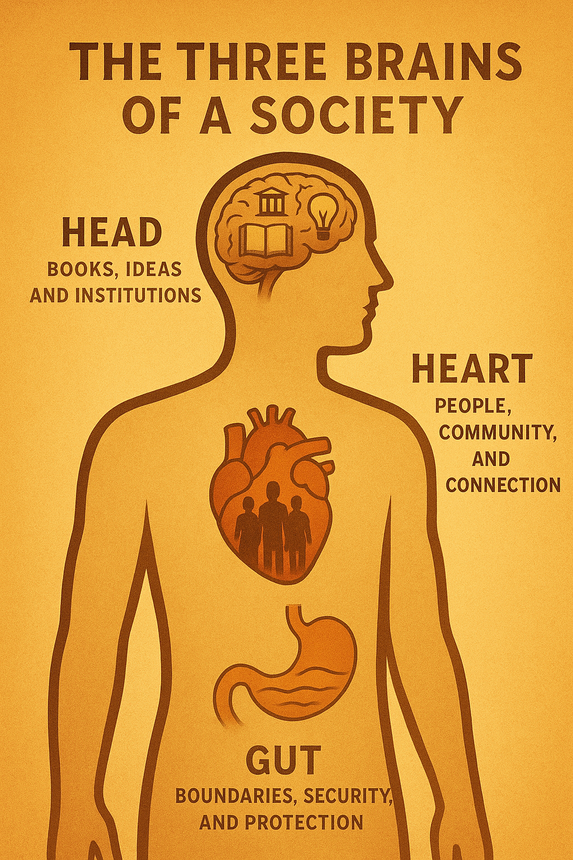
4. What If Societies Have Multiple “Brains” Too?
If individuals have a head, heart, and gut brain… Societies do too.
Here’s a way to think about it:
- Head Brain: our institutions and ideas: Government, law, education, media → how we make meaning together.
- Heart Brain: our social bonds: Community, culture, belonging → how we care for one another.
- Gut Brain: our boundaries and safety systems: Policing, economics, basic security → how we protect ourselves.
Healthy societies coordinate all three, as with human multiple brains, they need to operate interdependently. Unhealthy ones over-rely on one:
Too much Head → intellectual but disconnected
Too much Heart → caring but overwhelmed
Too much Gut → defensive, reactive, tribal
Which raises a question:
Where is our society currently leading from, head, heart, or gut? And what’s missing?
5. What If the Signals We Send Shape the Safety of All?
Every society sends signals that shape how safe people feel:
who is welcomed
who is feared
whose voice counts
whose pain is ignored
who is included or excluded
When those signals soothe → societies become creative, generous, and collaborative.
When those signals threaten → societies become brittle and divided.
Safety isn’t soft. It is the foundation of collective intelligence. As in the words of Grant Soosalu, “True wisdom is the ability to comprehend multiple perspectives.” Which makes me wonder:
If safety is the soil from which healthy societies grow, what are we planting right now?
6. What If Nations Could Regulate Themselves?
If individuals regulate through the sequence:
Regulate → Relate → Reason,
Could societies do the same?
Imagine political debates that first restored calm.
Imagine education systems that explicitly taught co-regulation.
Imagine justice systems that reduce threats rather than amplify them.
Imagine workplaces that understood nervous systems as much as KPIs.
This isn’t idealistic; it’s what the most stable, peaceful societies already do.
In fact, this model is rooted in the Neurosequential Model of Therapeutics, developed by Dr. Bruce Perry, which outlines how humans, and by extension, societies, move through states of regulation, connection, and clarity.
So perhaps the real question is:
What would a regulated society look and feel like, and what part could each of us play in creating it?
7. What If You Regulated Your Inner Society?
Before asking how a nation regulates itself, try asking this:
How do you regulate your inner society?
Head: Are your thoughts fuelling the threat or easing it?
Heart: Do your emotions open a connection or guard against it?
Gut: Do your boundaries come from integrity or fear?
A few gentle prompts:
“What signals of safety help me feel grounded?”
“Where might I be contributing to co-regulation in my relationships, or to dysregulation (dysfunction)?”
“What would it look like to respond from my regulated self this week?”
A calmer society begins with calmer people, not perfect people, just people paying attention.
8. Closing Thought
A society is not an abstract thing. It is all of us. Millions of nervous systems, interacting.
If individuals thrive through safety and connection, then nations must too.
Because when safety rises:
empathy rises
cooperation rises
intelligence rises
compassion rises
A regulated society doesn’t just function better… It feels more human.
/Passle/52fb8de8b00e7e0ac8b58c86/MediaLibrary/Images/2026-08-04-22-43-28-228-6a726b104b0fc817ee6f3cf7.png)