


- A teacher who values control above all else may create a classroom of compliance rather than curiosity.
- A manager who values perfection may build a team afraid to experiment.
One person’s operating system doesn’t just affect them. It quietly shapes the system around them.
Last week, we explored the idea that each of us is running a psychological operating system, written largely in childhood, full of old rules, inherited values, and assumptions we may never have consciously chosen.
But if that’s true for individuals…
What about societies?
If millions of people are running outdated operating systems, what kind of schools, workplaces, governments, and justice systems do they create?
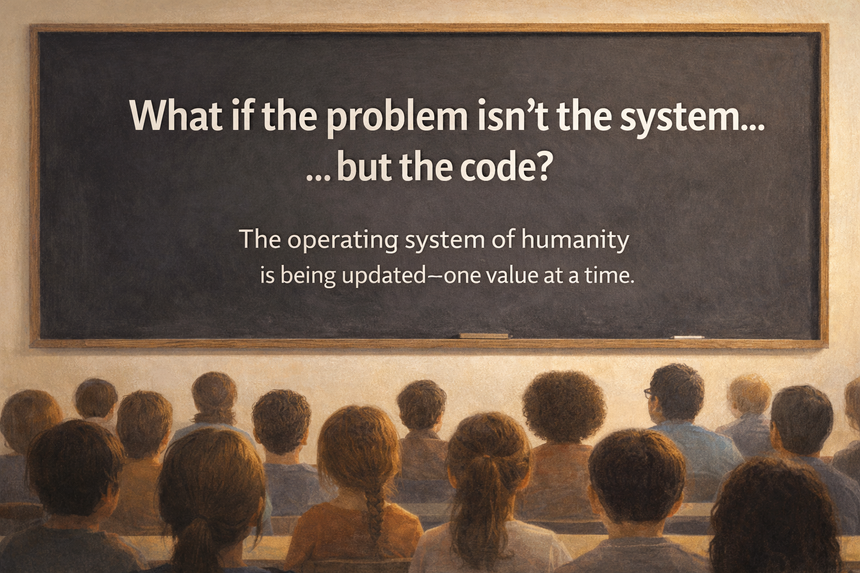
And what might change if we began to consciously update the collective OS, starting not with rules, but with values literacy?
Let’s explore this not as a blueprint, but as a series of questions worth sitting with.
1. Education: What If Schools Taught the Inner Operating System?
Schools teach us how the world works. They rarely teach us how we work.
What if, alongside maths and language, children learned:
How to recognise a value conflict, for example, fairness versus loyalty
How to question a belief that no longer fits reality
How to tell the difference between fear and intuition
How to regulate themselves before reacting
How to navigate disagreement without collapsing into defence
Think back to your own schooling. What did you learn about yourself?
About conflict, emotion, or what truly mattered to you?
For most of us, the answer is: very little.
We learned subjects, but not the operating system running beneath them.
So… what if that changed?
What if classrooms weren’t just places of academic literacy,
but spaces for learning how to understand the inner code that drives behaviour?
What if, instead of teaching children what to think, we taught them how to think about what matters?
Imagine classrooms asking questions like:
What value is driving my reaction right now?
Does this value still serve me?
What matters to you here, and how can we honour both?
What might change if education focused as much on inner alignment as external achievement?
2. Migration & Integration: What If We Saw Values Before Differences?
Integration is complex. It involves history, power, resources, policy, and real structural challenges.
And still, I wonder…
What if some of our deepest integration struggles are also about unspoken values colliding?
What if beneath debates about culture, language, or custom, there are quieter questions like:
What helps me feel safe?
What does dignity look like to me?
What do I need to belong?
I’m not sure if this replaces policy or boundaries. But I do wonder whether values conversations could sit alongside them.
What if integration programmes began not only with rules and expectations, but with mutual inquiry?
What matters most to you?
What are you protecting?
Where might our values align more than we assume?
Perhaps the core operating system, the human need for safety, dignity, and belonging, is more similar than we think, even if the interface (language, custom, expression) looks different.
And perhaps curiosity creates more stability than fear ever could.
3. Leadership: What If Leaders Became OS Architects, Not Controllers?
Many leadership models still run on old operating code: control people to get results, pressure improves performance, and fear maintains standards.
But what if leadership evolved from control to calibration?
Consider this: A leader may value speed and decisiveness. A team may value inclusion and thoroughness. If neither recognises the values beneath the behaviour, frustration escalates.
But what if leaders asked:
What value is this resistance protecting?
Are our decisions driven by fear or purpose?
Which organisational beliefs might need updating?
What would increase psychological safety here?
When leaders work with values instead of against them, something shifts:
Compliance becomes commitment.
Fear becomes creativity.
Control gives way to responsibility.
Not because people are softer, but because coherence reduces friction.
4. Conflict Resolution: What If We Fixed the Code, Not the Symptoms?
Most conflicts, at home, work, or in communities, don’t begin with malice.
They begin with threatened values.
fairness feels violated
autonomy feels constrained
belonging feels at risk
respect feels missing
When we argue about the surface issues, we stay stuck.
When we inquire into the value underneath, something softens.
Consider a recent conflict and gently ask:
- Which value felt threatened for me? (Was it fairness? Respect? Autonomy? Belonging?)
- Which value might have felt threatened for them?
- What would honour both, without one of us losing?
Conflict doesn’t disappear, but it becomes navigable.
Values aren’t obstacles. They’re signals.
And once we read the signal, we can work with the code.
5. Justice: What If We Asked a Different First Question?
If behaviour is the output of an operating system, then harm may sometimes point to damaged, outdated, or survival-based code.
I’m not certain what the “right” justice system looks like, and I’m wary of simple answers to complex harm.
But I do wonder:
What if justice asked what failed before asking who to punish?
What if accountability included repairing the inner OS, not just imposing consequences?
What if safety, regulation, and values literacy were part of preventing reoffending, not afterthoughts?
This isn’t about excusing harm. It’s about asking whether punishment alone ever updates the code that produced it.
There’s more to explore here, and I explore this more deeply in the forthcoming report - [Link will be here in January 2026]. For now, perhaps the question is enough:
Are we repairing systems, or reinforcing them?
6. A Reflection for This Week: Updating the OS Together
Before next week’s post, try sitting with this:
Where might your operating system be out of date?
Are you still living by a childhood rule that once kept you safe?
Are you defending a value you inherited but never chose?
Are you reacting to situations as a younger version of yourself would have?
And one more:
What operating system is your workplace, family, or community running?
And what small update might you quietly introduce?
Because when even one person updates their OS, the system around them feels it.
Human systems always change from the inside out.
So perhaps the invitation this week is simple:
What's one line of code you're ready to question, not to delete, but to understand?
For example:
- 'I must always put others first.'
- 'Asking for help is weak.'
- 'If I'm not perfect, I'm not enough.'
What's yours?
A Personal Share: mine used to be, ‘I’m not good enough’. This code served me well; it was one of my primary drivers, but it’s served its purpose, and I’ve now moved on.
/Passle/52fb8de8b00e7e0ac8b58c86/MediaLibrary/Images/2026-08-04-22-43-28-228-6a726b104b0fc817ee6f3cf7.png)