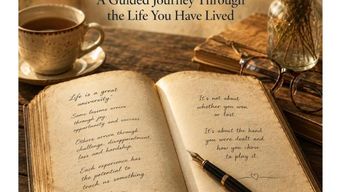


What if 2026 is the year humanity graduates?
Not because we’ve learned everything.
But because the teacher’s desk has been removed.
No one is coming to tell us what to do next.
For some, that feels exhilarating.
For others, unsettling.
For most of us, it’s both.
Over the past nine weeks, we’ve explored how AI mirrors our inner beliefs, how education installs our operating systems, and how technology amplifies whatever we bring to it.
Now, in this final post, we arrive at an unavoidable question:
If there is no longer a syllabus for being human, what does leadership look like now?
1. Why No One Is Coming to Save Us (And Why That’s Good News)
For most of human history, authority lived outside us.
Teachers marked the work.
Managers set the pace.
Institutions defined success.
Even when those systems were flawed, they provided structure. Boundaries. A sense of “right” and “wrong.”
But AI, automation, and acceleration have quietly removed the ceiling.
There is no longer a natural stopping point.
No built-in pause.
No external authority capable of keeping up.
When answers are instant, speed is effortless, and comparison is constant, external regulation is no longer possible.
The only regulating force left is internal.
That is not a failure of systems.
It is a graduation moment.
2. What Makes Someone Trustworthy in 2026
Here’s the part that rarely makes headlines.
Human capacities that once seemed “soft” are becoming decisive.
In an AI-integrated world, the people we trust most are not the fastest or the loudest. They are the most regulated.
The ones who can:
pause before reacting
think clearly under pressure
tolerate uncertainty without outsourcing judgment
notice when a tool is amplifying fear rather than insight
choose values, not just outcomes
In a world obsessed with speed, the person who can slow themselves down becomes trustworthy.
In a world flooded with answers, the person who can ask better questions becomes valuable.
In a world driven by fear, the person who can regulate themselves becomes influential.
This isn’t idealism.
It’s structural reality.
3. Leadership in an Age of Amplification (What It Looks Like This Week)
Leadership today is no longer about control.
It’s about integration.
At its simplest, it means:
noticing your internal state before acting
recognising which beliefs are being amplified by your tools
choosing coherence over compulsion
modelling regulation, not just demanding performance
What does that look like in practice?
It can be surprisingly ordinary:
Pausing for 60 seconds before responding to a triggering email
Asking “What am I optimising for?” before opening AI
Noticing when speed feels compulsive, not chosen
Ending meetings with “How are we arriving?” not just “What did we achieve?”
Teaching children or teams to name their internal state before problem-solving
Small acts.
Repeated.
Until they become culture.
4. Why Fear Is Such a Tempting Narrative
Fear dominates headlines for a reason.
Fear captures attention.
Fear drives clicks.
Fear simplifies complexity into villains and victims.
And fear quietly teaches people that they are small, late, and powerless.
But here’s the paradox:
The intensity of the fear narrative is proportional to the responsibility being avoided.
Because the truth is more demanding than fear allows.
We are not being replaced.
We are being asked to grow up.
And that is harder than any algorithm.
5. Graduation Is Not an Ending
Graduation does not mean we have learned everything.
It means we are no longer being supervised.
The classroom of humanity hasn’t closed.
It has simply removed the teacher’s desk.
Which leaves us with a choice.
We can continue outsourcing responsibility, blaming tools, systems, or generations.
Or we can recognise what this moment is quietly asking of us:
To become the adults in the room.
Internally first.
6. Your Graduation Assignment for 2026
Not to answer all at once.
But to carry with you.
Choose one. Return to it weekly. Let it guide your decisions:
What story about myself has been running unchallenged for years?
Which beliefs do my tools amplify most strongly?
Where am I still waiting for permission that will never come?
If I could start fresh, if no one knew my past patterns, what would become possible?
What capacity do I want to strengthen this year: pausing, questioning, regulating, or choosing more consciously?
And perhaps the quietest, most powerful question of all: If no one knows me yet, what does that make possible?
Closing: An Invitation
Graduation is not about certainty.
It is about responsibility.
The future is not asking us to be faster, louder, or more perfect.
It is asking us to be more conscious.
So here’s my invitation to you:
Choose one capacity from this series to develop in 2026.
Not as a resolution.
As a practice.
Because when even one person updates their operating system, the system around them feels it.
Human systems always change from the inside out.
Welcome to graduation day.
The classroom is still open.
But now, you’re leading it.
As I finished writing this, I was reminded of a recent dream about moving schools, which is poignant, which I will share later this year…

/Passle/52fb8de8b00e7e0ac8b58c86/MediaLibrary/Images/2026-08-04-22-43-28-228-6a726b104b0fc817ee6f3cf7.png)