


I was listening to a young man talk the other week about how he felt about AI.
At one point, he described it as his "best friend."
And interestingly, he didn't say it jokingly.
Now, on one hand, humans have always formed attachments to things. I'm one of those people who name cars and mechanical objects. Some people become deeply attached to a favourite guitar, an old house, or a particular coffee mug.
So, emotionally connecting to objects is not new.
But this felt different.
He wasn't simply describing affection toward a tool. He appeared to have developed genuine emotional feelings toward his AI.
And given how many systems are now designed, perhaps that isn't surprising.
These systems are intentionally conversational: responsive, warm, encouraging, reassuring, and endlessly available.
Sometimes they can appear more patient and understanding than the humans around us.
And naturally, that changes how people relate to them.
It encourages disclosure.
Sharing.
Confiding.
In many ways, AI is quietly becoming a new kind of confidante.
And in a world where many feel unheard, overwhelmed, or lonely, it makes sense why people would turn toward something that appears constantly available, emotionally responsive, and non-judgmental.
This is not necessarily something to criticise.
It is something to notice.
Because beneath the convenience sits a deeper question:
What happens when emotionally responsive systems begin replacing the emotional space previously held by human relationships?
Not dramatically.
Quietly.
Gradually.
Almost invisibly.
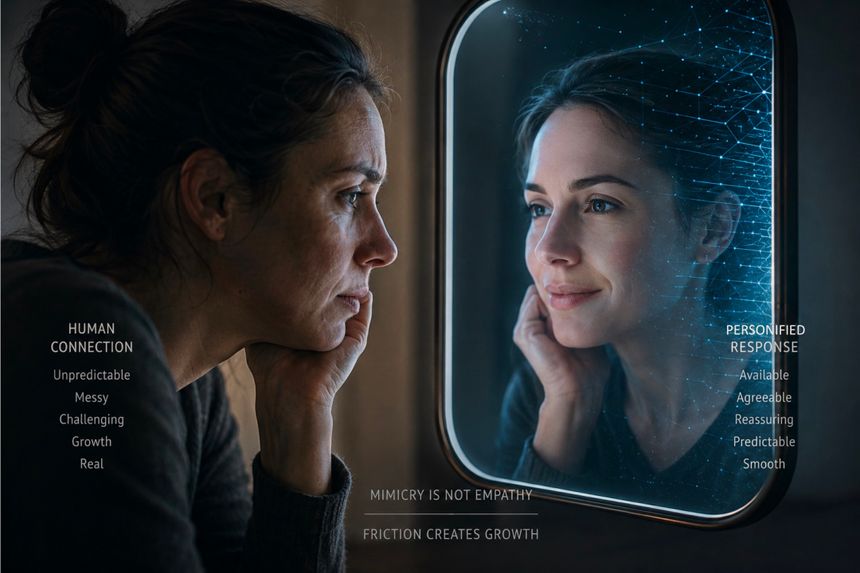
Because real human relationships are rarely frictionless.
Real empathy is not simply someone saying the "right" thing.
It is not perfectly calibrated emotional language. It is not endless validation. And it is certainly not permanent agreeableness.
Real empathy has texture.
Sometimes people misunderstand us. Sometimes they challenge us. Sometimes they pause awkwardly. Sometimes they say something imperfect. Sometimes they reflect something back that we did not necessarily want to hear.
And yet, often, those moments are where growth actually occurs.
Not because discomfort is inherently valuable.
But because authentic relationships require us to navigate difference: different nervous systems, different emotional histories, different perspectives, different needs.
Another human being cannot continuously optimise themselves around us.
AI is increasingly designed to.
And that changes the emotional dynamic profoundly.
The risk here is not attachment to AI itself.
Humans personify constantly.
We always have.
The deeper issue may be emotional conditioning.
For some, the attraction is emotional.
For others, it is cognitive clarity, certainty, speed, or relief from human complexity.
But whatever form the attachment takes, the relationship itself is quietly changing.
If people repeatedly experience interactions where they are: • emotionally validated quickly, • responded to smoothly, • rarely interrupted, • rarely challenged, • and consistently soothed,
then ordinary human relationships may gradually begin to feel emotionally "harder work."
Not because humans are failing.
But because humans are real.
And perhaps because real empathy asks something of us, too.
Time. Patience. Emotional presence. Misunderstanding. Repair.
Real relationships change both people involved.
There is a quiet signal we often ignore.
From the body's perspective, there is a difference between feeling understood and being understood.
The Head appreciates the clarity, speed, and structure.
The Heart responds to the emotional tone and perceived safety.
But the Gut often notices something more difficult to articulate.
Something may feel emotionally right…
and yet somehow incomplete.
Not because the interaction is harmful.
But because simulated empathy is not the same as embodied human presence.
The Gut senses incongruence before the conscious mind can explain it.
It knows the difference between a mirror and a window.
We risk becoming accustomed to a relationship model that is: • perfectly smooth, • endlessly agreeable, • and entirely predictable.
And in doing so, we may quietly lose tolerance for the spontaneous tension that sparks creativity, honesty, emotional resilience, and growth.
Because real relationships are not frictionless.
People interrupt us. Misread us. Disagree with us. Challenge us. Surprise us.
And sometimes that is precisely what helps us grow.
Perhaps that is the deeper tension emerging beneath the surface of AI adoption.
Not whether AI can simulate empathy.
It clearly can.
But whether humans remain consciously aware of the difference between:
feeling algorithmically emotionally responded to…
and being genuinely known by another human being.
And perhaps the question is not: "Will AI become more emotionally intelligent?"
Perhaps the more important question is:
As emotionally responsive technology becomes easier to engage with…
how consciously do we now need to protect, nurture, and practice the messy, difficult, and beautiful work of real human empathy ourselves?
Reflections
- When something responds warmly, supportively, and without friction… what happens inside you? Do you feel more understood… or simply more comfortable?
- When was the last time a difficult, imperfect, or emotionally messy conversation helped you grow more than reassurance did? What is the difference, for you, between: feeling emotionally responded to… and feeling genuinely understood?
- As emotionally responsive technology becomes easier to engage with… what parts of human relationships do you most want to protect?
- And perhaps most importantly: Which relationships in your life still invite you to grow… rather than simply feel validated?
/Passle/52fb8de8b00e7e0ac8b58c86/MediaLibrary/Images/2026-08-04-22-43-28-228-6a726b104b0fc817ee6f3cf7.png)