

Last week, we explored the idea that society behaves like a giant nervous system - a living body that can become dysregulated, overwhelmed, grounded, or resilient depending on how its people feel.
Which leads to a natural follow-on question:
What regulates a society from the inside?
What anchors it?
What shapes how we react, decide, connect, or collide?
For individuals, the answer is values.
But what if the same is true for societies?
What if values are the curriculum we've never formally taught, yet desperately need?
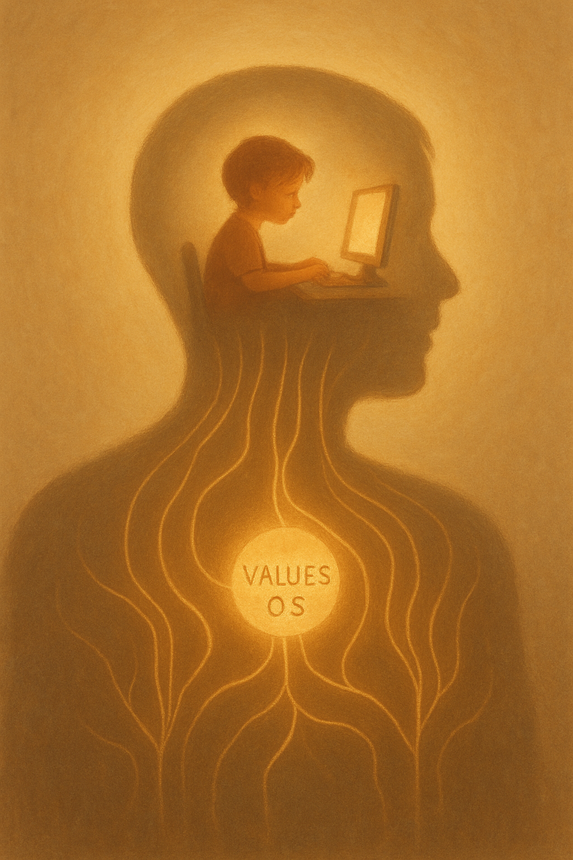
And what if many of us are navigating modern life using an operating system that was written in childhood?
1. What If Your Values Are Your Operating System?
Think back for a moment, not to something dramatic, but to something ordinary.
Someone praised you.
Or criticised you.
Or ignored you.
Or soothed you.
Or startled you.
These small moments acted like invisible programmers.
From them, you learned:
"What matters?"
"What keeps me safe?"
"What gets me in trouble?"
"What earns me approval?"
"What does love look like?"
"What must I protect?"
"What must I hide?"
Those lessons didn't stay in childhood. They became your values, not soft abstract ideals, but deep rules in your inner operating system.
Here’s the part we rarely think about:
Most people are running a 2025 life on an operating system designed by a five-year-old.
Values are formed young.
Beliefs crystallise soon after.
And together, they quietly guide how we see the world.
So the question becomes:
If your OS was built when your world was small… how well does it serve you now?
2. Values vs Beliefs — Magnetic North and the Map
Most people use the words' values' and ‘beliefs’ casually, but they’re not the same.
Think of them this way:
Your values are magnetic North: Invisible, persistent, guiding you whether you notice it or not.
Your beliefs are the map: Your interpretation of reality, updated, revised, rewritten as you gather new information.
Someone may deeply value honesty (magnetic North), yet believe telling a friend the truth about their unfortunate haircut would do more harm than good (the map).
The value stays steady.
The belief adapts.
Values set direction.
Beliefs interpret reality.
And because most values form early, before we have adult logic, adult perspective, or adult agency, a lot of people end up following an inherited North without ever asking:
Is this still my North?
3. Would You Let a Three-Year-Old Program Your Computer?
Imagine this: you buy a brand-new laptop. It’s fast, powerful, and full of potential. Then someone says:
“Before you start using it, we’ll let a three-year-old write the operating system.”
Would you agree?
Because that’s what most of us unknowingly do.
Our OS, our core values, our emotional rules, our sense of what’s safe, was written by:
A Toddler seeking comfort
A Child trying to fit in
A Teenager searching for identity
A Young person still learning who they are
A three-year-old’s OS is perfect for a three-year-old’s world. But does it still serve your adult reality?
The story of the high-achieving, anxious employee illustrates this perfectly:
Her OS rule was written in childhood:
“If I’m perfect, I’ll be seen. If I’m seen, I’ll be loved.”
It served her at seven… But it exhausted her at thirty-five.
Once she saw it, she could update it.
4. How Often Should I Upgrade My OS, and What's The Risk If I Don’t Update
A childhood OS running an adult life can create:
• Outdated values
• Inherited fears
• Reactive decisions
• Loyalty to beliefs that were never yours
• Assumptions formed by a child, applied in adult environments
• Behaviours that feel like “just how I am”
But what if they’re not “how you are”? What if they’re “how your OS operates”?
And what if you could update it?
This is where coaching, reflection, and conscious development become powerful.
Not because we are broken, but because our OS is outdated.
5. Why This Matters for Societies Too
If individuals operate from old OS code… societies do too.
Cultural values, the collective operating system, were shaped by:
Outdated eras
Fear-based norms
Historical wounds
Unquestioned assumptions
Childhood survival logic, scaled up
A society built on an OS of:
“People learn through fear”
or “Difference is dangerous”
or “Power must control”
…will behave like a body stuck in survival mode (Barrett Values - Level 1)
Which brings us back to the question from Post 5:
If society behaves like a nervous system, shouldn’t we examine the values that regulate it?
6. Values Literacy — The Curriculum We Never Teach
We teach children subjects. But we rarely teach them about themselves.
Values literacy means recognising, articulating, and consciously choosing the values that guide your life.
Yet we almost never teach people how to:
• recognise a value misalignment
• distinguish inherited values from chosen ones
• update beliefs that no longer serve them
• navigate value conflicts compassionately
• notice when fear is masquerading as a value
• understand the “why” behind their reactions
These are not luxuries.
They are the foundations of conscious adulthood.
In Barrett Values Centre language:
Values literacy moves people from survival, to belonging, to authenticity, to contribution.
But only if they learn how.
7. A Few Gentle OS-Upgrade Questions
These questions are not for judgment — only for curiosity:
• What do you fiercely protect — even when it costs you peace?
(A clue to a core value running unconsciously.)
• What do you refuse to compromise on — even when flexibility would help?
(A value operating rigidly.)
• When you feel most “yourself,” what matters most in that moment?
(Your authentic values.)
• What do you judge harshly in others?
(Judgment often reveals unconscious values or unmet needs.)
• If your OS were a phone app, would you update it… or keep running the old version?
8. Closing Thought — Before Part 2
Values aren’t abstract ideals.
They are the quiet regulators of behaviour.
They tell societies what to tolerate,
institutions how to treat people,
and individuals how to interpret the world.
And they can be updated — consciously, carefully, and wisely.
If we want a more conscious society, we must start with a more conscious relationship to our own operating system.
Next week, in Part 2, we’ll explore how values literacy can reshape:
education, integration, leadership, conflict resolution —
and perhaps even justice itself.
Because if we can update our personal OS… we can update our collective one too.
/Passle/52fb8de8b00e7e0ac8b58c86/MediaLibrary/Images/2026-08-04-22-43-28-228-6a726b104b0fc817ee6f3cf7.png)