Before deciding whether you agree or disagree with someone, it may be worth pausing for a moment and asking:
Are we even having the same conversation?
Two villagers in 1720.
One misunderstands something the other has said at the local market.
A few sharp words are exchanged.
Both return home irritated.
Over the following days, they encounter one another again.
They see each other's faces.
Hear each other's tone.
Observe their lives continuing as normal.
Perhaps one clarifies what they meant.
Perhaps the other realises they interpreted the comment incorrectly.
Perhaps they simply move on.
The misunderstanding remains largely between the two people.
The opportunity for repair is ever-present.
Now imagine a misunderstanding in 2026.
A comment is posted online.
Perhaps written quickly.
Perhaps interpreted differently from how it was intended.
Within minutes, people begin responding.
Some agree.
Others object.
Some assume motives.
Others assign intentions.
The comment is shared, reposted, screenshotted and discussed.
By lunchtime, thousands may have formed opinions about what the author meant.
Not one of those people has heard the author's tone of voice.
Seen their facial expression.
Observed their circumstances.
Or asked what they intended.
Yet certainty spreads rapidly.
Understanding moves much more slowly.
Social media and instant messaging did not create misunderstanding.
Human beings have probably misunderstood one another for as long as human beings have existed.
What these technologies have done is amplify one of our most basic human limitations: our tendency to misunderstand one another.
They remove context while increasing speed.
And they create an interesting illusion:
The illusion that everyone is having the same conversation.
But are they really?
The Illusion of Shared Meaning
Human beings do not experience reality directly.
We experience our interpretation of reality.
Everything is filtered through:
beliefs
assumptions
emotions
memories
identity
expectations
current circumstances
A comment one person finds helpful, another may find critical.
A statement one person sees as humorous, another may find offensive.
The words remain unchanged.
The meaning shifts.
Perhaps many disagreements, online and offline, work in exactly the same way.
Two colleagues.
Two family members.
Two strangers on social media.
Each person assumes they are discussing the same thing.
Yet each may be responding to a different version of reality.
One is responding to direct experience.
Another to something they read.
Another to something they were told.
Another to a painful experience from years ago.
Another to an assumption they do not even realise they are making.
The discussion appears shared.
The starting points are not.
Perhaps this is why so many conversations become difficult.
We focus on whether we agree or disagree before establishing whether we are even discussing the same thing.
When the emotional reaction is strong, it may be worth pausing for a moment.
Not to decide whether you agree.
Not to decide whether you disagree.
But simply to ask:
Am I responding to what was actually said?
Is this message triggering an unresolved event in my past?
Am I responding to the story I have created around it?
What might the other person know, see, or be experiencing that I cannot currently see?
The next time a disagreement feels particularly intense, it may also be worth asking:
Are we having the same conversation?
What context am I missing?
The other person's?
My own?
Or both?
Technology allows messages to travel around the world in seconds.
Understanding still moves at the speed of human awareness.
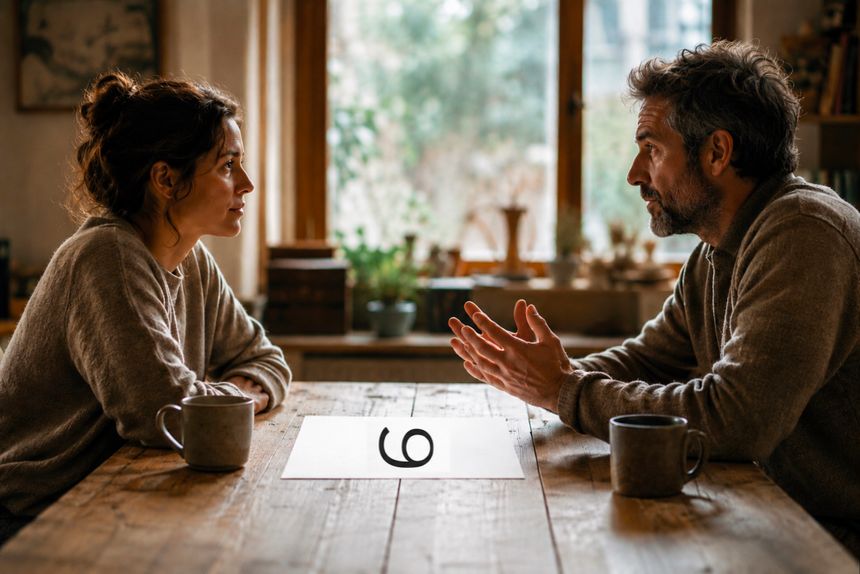
Perhaps wisdom begins the moment we become curious enough to wonder whether there might be more than one valid way to see the same piece of paper.
Or, as Grant Soosalu, co-creator of mBraining, often said:
"True Wisdom is the Ability to Comprehend Multiple Perspectives."
 unknownx500